

In 2025, customer service expectations have reached new heights because of rapid advances in digital technology coupled with elevated demands for seamless, customized experiences. Today’s consumers expect instantaneous support, engaging interactions, and solutions that are just right for the channel of their choice. Because of this, inbound call centers have come to be the backbone of customer-centric businesses, acting first for a communication tool and representing an important touchpoint for the development of trust and loyalty.
This blog will examine how inbound call center software has changed customer service in the year 2025. We will talk about the latest trends and technology, as well as the things ICallify platforms can accomplish, benefiting those organizations motivated to surpass customer expectations. Whether you are running a business, loving technology, or setting standards in the experiential economy, find out about the new inbound call center that changed service delivery and the dawn of a focus on excellence.
What is Inbound Call Center Software?
The inbound call center is a focused service unit where agents handle incoming calls from customers demanding support, information, or assistance with products and services. While outbound centers make calls, inbound centers are designed to receive and solve customer calls and inquiries harmoniously, ensuring a good customer experience.
Key Features of Inbound Call Center Software:
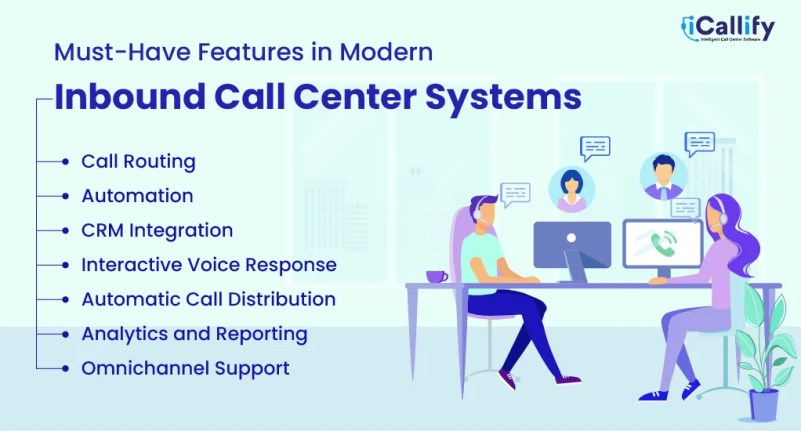
- Call Routing: Incoming calls are directed towards the agent or department best suited for handling them, usually based on intelligent criteria like the specific expertise of the agent, available time, or the nature of the customer’s inquiry. This ensures reduced waiting times and hence faster resolution.
- Interactive Voice Response (IVR): Gives users an automated handholding through menus of options to resolve their queries by themselves or speak to an agent if there arise any complex issues.
- Automatic Call Distribution (ACD): Allocates calls among agents based on certain predetermined rules so as to distribute the workload evenly and reduce hold times for customers.
- Analytics and Reporting: Tracks key metrics such as call volume, average handling time, agent performance, and customer satisfaction-which provide businesses insight into trends and areas to improve upon.
- Omnichannel Support: Offers multiple communication channels such as the telephony channel, emails, chat, and social media in a single solution. This way, simply through one single dashboard, agents can work from all channels, servicing their customers.
- CRM Integration: Allows linking to customer relationship management systems so that agents will have access to their customers’ history and preferences for high service personalization.
- Automation: Auto-manages mundane tasks, such as log calls or basic troubleshooting, thus allowing agents to dedicate their time to addressing more complex customer requirements.
Traditional vs. Modern Inbound Solutions
| Aspect | Traditional Inbound Call Centers | Modern Inbound Call Center Software |
| Technology | On-premise phone systems, limited automation | Cloud-based, AI-driven, highly automated |
| Channels | Voice calls only | Omnichannel (voice, chat, email, social media) |
| Scalability | Fixed capacity, hard to scale quickly | Easily scalable, supports remote and hybrid teams |
| Data & Analytics | Basic call logs, minimal analytics | Advanced analytics, real-time dashboards |
| Customer Experience | Long wait times, manual call routing, and limited self-service | Intelligent routing, IVR, self-service options |
| Agent Tools | Basic telephony, limited access to customer data | Unified dashboards, CRM integration, and automation |
Modern inbound call center software revolutionizes customer service by making support more accessible, efficient, and data-driven. It empowers businesses to deliver faster resolutions, personalized experiences, and seamless interactions, meeting the high expectations of today’s customers
Most Difficult Customer Service Problems for 2025
The new customer service era in 2025 will be characterized by higher expectations, demand for speed, and the creation of seamless experiences across channels. Below are the 2025 major challenges in customer service:
Higher Expectations of 24/7 Availability
Today, customers demand support anytime and anywhere. Digital interactions have grown 50% since 2020, and 93% of service teams say expectations are higher than ever, putting businesses under the pressure of delivering around-the-clock assistance. Failing to meet these expectations could mean quick loss of loyalty, 86% of customers MIGHT leave a brand after just two bad experiences.
Speedy and Personalized Support
In this day and age, demand for personalized experiences has hit an all-time high. More than two-thirds of people (68%) believe that every interaction should be personalized, and 65% expect faster responses now than they did five years ago. However, only 22% of organizations unify their customer data, which creates the challenge of providing consistent and personalized service at scale.
Need for Omnichannel Interaction
Customers want to connect on their terms. Perhaps they do so by phone, maybe with a chat, or by e-mail, or even social media. Seamless omnichannel support has become a must-have for businesses, requiring them to unify all channels to meet customers wherever they are. Fragmented tools and disjointed processes continue to be among the few barriers faced by many organizations.
Efficiently Handling Large Customer Query Volumes
Contact volumes keep increasing, with 71% of support leaders indicating inquiries have been on the rise since 2020. Agents are juggling increasingly complex and diverse responsibilities, and 77% of them cite a growing workload in the last year. Without appropriate tooling and automation, it becomes a sizeable challenge to manage volumes while still keeping quality in check.
These challenges highlight why modern inbound call center software becomes vital, as it empowers organizations to meet increased demands, provide personalized and omnichannel support, and manage huge volumes efficiently without compromising on quality.
Benefits of Modern Inbound Call Center Software
Faster resolution and greater customer satisfaction
This new age inbound call centre software employs smart call routing, AI-powered tools, and real-time analytics to connect the customer quickly with the most suitable agent. This, in turn, minimizes wait times and call transfers, thus fostering quicker resolution of issues. Relevant AI-powered self-service options like IVR and chatbots deal with immediate and pondering queries on the double, so agents can concentrate on more challenging customer assistance. Rapid solutions translate to personalized attention, earning pride and customer loyalty.
Lower costs with automation
Automation in present call center solutions supports and speeds up several repetitive processes like call distribution, data entry, and follow-ups. This keeps the support team on the smaller side while keeping building infrastructure on the cheap, operating on cloud platforms. All of these efficiencies translate into a nice big basin full of treasures in the form of cost savings while maintaining service quality.
Productivity increase for agents and reduction of burnout
Routine processes are automated, and agents are provided with integrated CRM access and knowledge bases so that issues are handled more quickly with less stress. Real-time coaching and performance insights enable managers to further support their agents while reducing burnout and elevating morale. A better working environment translates into higher productivity and better customer interactions.
A Seamless Customer Experience Across Channels
Modern inbound call centers adopt omnichannel approaches, forging an integration between calls, chats, social media, and much more into one platform.-Customers can reach out to the support team through their preferred channel without having to repeat themselves, thereby enabling smooth handoffs and consistent service down the line. This seamless customer experience strengthens trust and engagement.
This summary points out that by 2025, inbound call center software will fuse speed, cost-efficiency, agent well-being, and omnichannel consistency to conceptualize the best customer experience.
Use Cases: Industries Adopting the Change
e-Commerce and Retail Sector
Customer expectations have necessitated fast and personalized support in eBusiness to inquire if something is right-return-request tracking is just too slow. In 2025, the e-Commerce Call Center Software integrates AI chatbots along with omnichannel capabilities, supplying support over the phone, via chat, via email, and the like, including social media. The platform updates inventory in real-time, develops personalized product recommendations, and immediately resolves customer issues, thereby building customer loyalty and lowering operational costs. It also helps during peak seasons, allowing the automation of processes where necessary to retain service quality.
Healthcare
Patient communication in healthcare is very sensitive and regulated. Healthcare Call Center Software Solutions in 2025 form a system that will guarantee HIPAA compliance, secure data, and integrate with an Electronic Health Records system. They allow top scheduling, coordinate telehealth events, and support 24/7 AI-powered virtual assistant services delivering rapid responses to patient queries. Cloud-based healthcare call centers enable remote work for agents and facilitate seamless patient engagement, improving care outcomes and operational efficiency.
Financial Services
A customer-centric industry requires safe, compliant, and highly reactive customer service. Financial Contact Center Software in 2025 provides top-notch encryption with fraud detection and AI-powered analytics for delivering personalized financial advice and customer support. These solutions deal with advanced queries on banking, insurance, and investments requiring regulatory compliance; thus, omnichannel support allows customers to seamlessly switch between calls, chats, and secure messaging to build trust and increase customer satisfaction.
Travel and Hospitality
Travelers expect quick, accurate information and flexible support. Modern inbound call center software in this sector integrates with booking systems and real-time travel updates, with multilingual support for handling reservations, cancellations, and customer feedback efficiently. AI tools forecast customer needs, personalize offers, and handle disruptions proactively for a smooth and memorable travel experience.
Government and Public Services
Government agencies use sophisticated call center software to improve citizen engagement and service delivery. These platforms must take thousands of calls per day, provide multilingual support, and integrate with public databases to fast-track applications, be it for benefits, licensing, or emergency dispatch. Automated systems work to minimize wait time, thus creating greater transparency, which ultimately breeds public trust and satisfaction.
This overview demonstrates that the Healthcare Call Center Software, eCommerce Call Center Software, and Financial Contact Center Software are at the heart of modern customer service transformations across various industries in 2025, driving efficiency and security to provide excellent customer experiences.
Final Thoughts
Since 2025, inbound call center software has been transforming the global customer service landscape through the application of AI automation, omnichannel support, and real-time analytics, providing speedy, highly personalized, and tailored customer experiences. This kind of software reduces running costs and agent concerns while empowering the business to predict customer needs with extra efficiency and accuracy.
Today, with changing customer expectations, one must actively upgrade to modern inbound call center platforms such as iCallify. Some cutting-edge features, such as those in iCallify, include AI-based call routing, smart automation, and deep CRM integrations that allow companies to continue providing top-notch service while enhancing agent productivity and operational flexibility.
Have any questions, or are you ready to revolutionize your customer service? Connect with us today and see how our state-of-the-art inbound call center solutions can power your business!
Author
